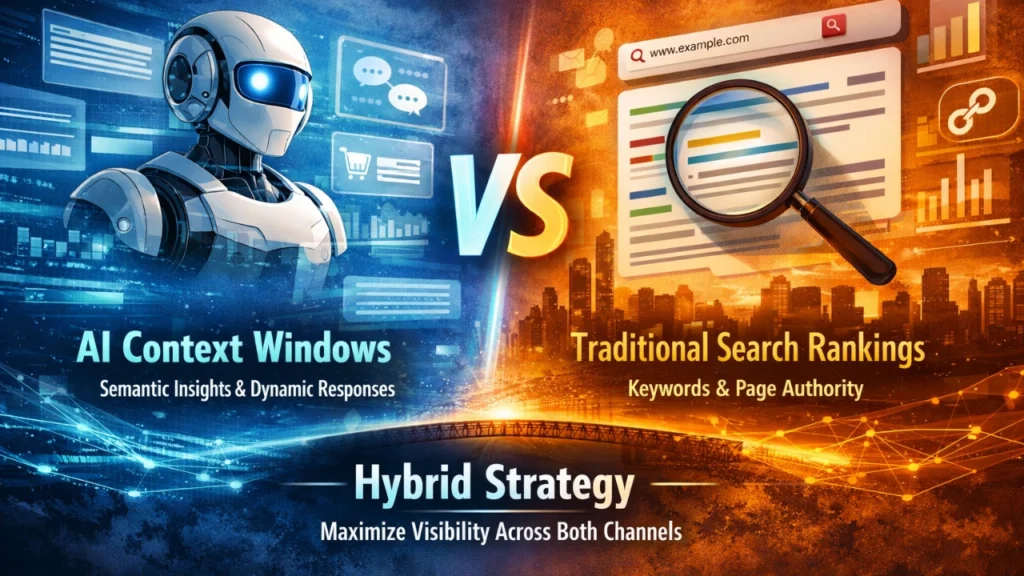
Your business faces a fundamental shift in how consumers discover you online. AI platforms like ChatGPT and Perplexus now handle 10% of product research queries, while Google still drives 43% of e-commerce traffic. The difference? AI context windows process vast amounts of data to generate contextual responses, while traditional search rankings match keywords to snippets.
This isn’t about choosing sides. It’s about understanding how AI context windows fundamentally differ from the PageRank algorithms you’ve optimized for over the past two decades. The businesses that master both channels will dominate visibility in 2026.
Quick Verdict
AI context windows win for conversational queries and future-proofing your visibility strategy. Traditional search rankings still dominate high-volume discovery and initial awareness.
The real winner? A hybrid approach that captures both channels. Snezzi’s platform tracks your brand mentions across AI responses and traditional search simultaneously, giving you complete visibility into where your optimization efforts deliver results.
Also Read


Most businesses waste resources optimizing for one channel while ignoring the other. That’s leaving money on the table.
Comparison Criteria

Five factors determine which visibility strategy works best for your business:
Context Scope measures how much information each system can process. AI context windows now reach 10 million tokens in Llama 4 Scout, roughly equivalent to 7.5 million words. Traditional search examines individual pages and ranks them based on authority signals.
Relevance Determination shows how matches happen. AI uses semantic understanding across entire conversations, while traditional search relies on keyword matching and link analysis. The difference affects which content surfaces for ambiguous queries.
Update Frequency impacts how quickly your changes appear. AI windows access real-time data through API calls, while traditional crawls can take days or weeks.
Optimization Strategies require completely different tactics. AI prioritizes topical depth and structured content, while traditional focuses on backlinks and domain authority.
Impact on Business Visibility varies by industry. (Artificial Intelligence)AI search visitors convert at 4.4x higher rates for complex purchases, but traditional still delivers higher absolute traffic volume.
AI Context Windows: Detailed Breakdown
AI context windows represent the maximum number of tokens a language model can process in a single interaction. Think of tokens as subword units, roughly 0.75 words each, that form the model’s short-term memory.
Gemini 1.5 Pro processes up to 2 million tokens, equivalent to 5,000 pages of text. Llama 4 Scout pushes this to 10 million tokens. Claude Sonnet 4 offers 200,000 to 1 million tokens with extended beta access. GPT-5.2 provides 400,000 tokens with a significantly reduced hallucination rate of 6.2%.
These massive windows enable holistic understanding. The model can analyze your entire product catalogue, customer reviews, and technical documentation simultaneously to generate relevant responses.
But size creates problems. Models exhibit “lost in the middle” performance degradation, where information buried in the centre of long contexts gets ignored. Recall rates drop sharply for middle-positioned data, even in million-token windows.
The pros: Semantic relevance beats keyword matching for nuanced queries. Dynamic responses adapt to conversation flow. Context carries across multiple interactions.
The cons: Model-dependent variability means your content performs differently across ChatGPT, Claude, and Perplexity. Quadratic compute scaling makes full window usage prohibitively expensive. Effective windows run at 30-50% of advertised capacity in real-world applications.
AI context windows excel for long-tail queries, where users describe problems rather than searching keywords. Your technical documentation and detailed product guides become discovery assets instead of post-purchase resources.
Traditional Search Rankings: Detailed Breakdown
Traditional search relies on algorithms that crawl, index, and rank individual web pages. PageRank evaluates authority through backlink networks. On-page signals include keyword placement, meta tags, and content structure.
The system prioritizes snippets. Google extracts 150-160 characters that match the query, displays them in results, and drives clicks based on relevance perception. Featured snippets and knowledge panels offer enhanced visibility for structured content.
Backlinks remain the dominant authority signal. A page with 100 quality links from authoritative domains outranks better content with weaker link profiles. Domain age, SSL certificates, and mobile optimization contribute secondary signals.
The pros: Proven scale reaches billions of daily searches. Broad reach captures users at the awareness stage. Established best practices provide clear optimization paths.
The cons: Snippet limitations reduce context to a few sentences. Keyword rigidity misses semantic variations. Algorithm updates can tank rankings overnight. Slower adaptation means content changes take weeks to reflect in rankings.
Traditional search dominates initial discovery. When someone searches “CRM software,” they’re researching categories, not asking specific questions. Your ranking determines whether you enter their consideration set.
The static nature creates predictability. Once you rank, traffic flows consistently until competitors outrank you or algorithms change. AI responses vary based on conversation context, making traffic less predictable.
Side-by-Side Comparison Table
| Criteria | AI Context Windows | Traditional Search |
| Context Scope | Up to 10M tokens (7.5M words) | Single page + metadata |
| Relevance Method | Semantic understanding across conversation | Keyword matching + PageRank |
| Update Speed | Real-time via API | Days to weeks (crawl dependent) |
| Optimization Focus | Topical depth, structured content | Backlinks, keywords, domain authority |
| Traffic Predictability | Variable by conversation | Consistent when ranked |
| Conversion Rate | 4.4x higher for complex purchases | Lower but higher volume |
| Content Requirements | Detailed, contextual answers | Snippet-optimized, keyword-focused |
| Cost to Rank | Content quality + monitoring | Links + technical SEO |
The table highlights AI’s edge in context depth and semantic relevance. Traditional search wins on traffic volume and predictability. Your business needs both.
Pros and Cons Summary
AI Context Windows Pros: Deeper semantic insights capture intent beyond keywords. Adaptability responds to conversation flow and follow-up questions. Future-proofing positions you for growing AI search adoption.
AI Context Windows Cons: Token limits still constrain processing despite expansion. Opacity makes it harder to understand why content surfaces or doesn’t. Model variations require testing across multiple platforms. Lost in the middle effects reduce reliability for long contexts.
Traditional Search Pros: Reliability delivers consistent traffic from established rankings. Volume generates more absolute visitors even at lower conversion rates. Clear metrics show exactly what’s working.
Traditional Search Cons: Keyword rigidity misses semantic variations and natural language queries. Slower adaptation delays the impact of content improvements. Algorithm dependency creates ranking volatility outside your control.
Choose based on how your audience searches. B2B buyers researching complex solutions increasingly use AI chat for detailed comparisons. Consumer products still see dominant traffic from traditional search.
AI search users conduct 20% more sessions post-adoption, compounding your visibility needs. Ignoring either channel means missing a significant portion of your potential customers.
Use Cases: When to Prioritize Each
Prioritize AI context windows for conversational commerce. ChatGPT shopping queries jumped 2% to reach 9.8% of total searches. Users ask detailed questions like “best CRM for 50-person sales team with Salesforce integration” rather than searching “CRM software.”
Your detailed product documentation, comparison guides, and technical specifications become primary discovery assets. AI models pull from this content to answer specific questions that traditional snippets can’t address.
Stick to traditional search for evergreen content and broad awareness. How-to guides, industry glossaries, and category pages still drive massive traffic from Google. Your blog posts ranking for “what is marketing automation” capture users at the research stage.
Hybrid strategies work best for most businesses. Allocate 60% of effort to AI optimization and 40% to traditional SEO if your audience skews technical or high-consideration. Reverse the ratio for impulse purchases and local services.
Snezzi tracks both channels simultaneously, showing which content drives AI citations versus traditional rankings. You’ll see exactly where your optimization budget delivers returns instead of guessing based on partial data.
Final Recommendation
Adopting a hybrid approach with balanced attention to AI context windows and traditional search can support sustainable visibility growth.Content should be structured to perform well in both environments.
Detailed, context-rich answers can increase the likelihood of being referenced in AI-generated responses, while clear headings, concise summaries, and structured formatting remain important for traditional search engines. Implementing schema markup can further improve how content is interpreted across systems.
Platforms like Snezzi, combined with structured AI SEO services, enable organizations to monitor how their content appears across AI assistants and traditional search results. Tracking prompt visibility, competitive citations, and source attribution provides insight into which content assets contribute to brand mentions and overall visibility.
Execution can be managed internally or through structured optimization processes that focus on measurable outcomes. Ongoing tracking and periodic reporting allow businesses to evaluate citation growth across platforms such as ChatGPT, Claude, Perplexity, and Google.
Conclusion
AI context windows and traditional search rankings serve different roles in a visibility strategy. Context windows prioritize semantic relevance and conversational intent, while traditional search relies on keyword signals and authority to drive large-scale discovery.
Hybrid approaches often outperform single-channel strategies. AI-driven visibility can generate higher-intent engagement, whereas traditional search delivers broader traffic reach. Together, they support coverage across the full research journey.
Tools such as Snezzi help monitor performance across both AI assistants and traditional search, tracking citations and organic visibility to identify where optimization efforts may have the greatest impact.