
If you’ve been keeping an eye on the crypto markets lately, you’ve probably noticed Ethereum (ETH) has had a rough few months. From its all-time highs of nearly $5,000 back in late 2025, ETH has tumbled down to the $1,900–$2,100 range — and investors, developers, and tech enthusiasts are all asking the same question:
“Is this a crisis — or an opportunity?”
Let’s break it all down. No jargon overload. Just a clear-eyed look at what’s going on with the world’s second-largest cryptocurrency.
ETH Price Trend at a Glance (Aug 2024 – Mar 2026)
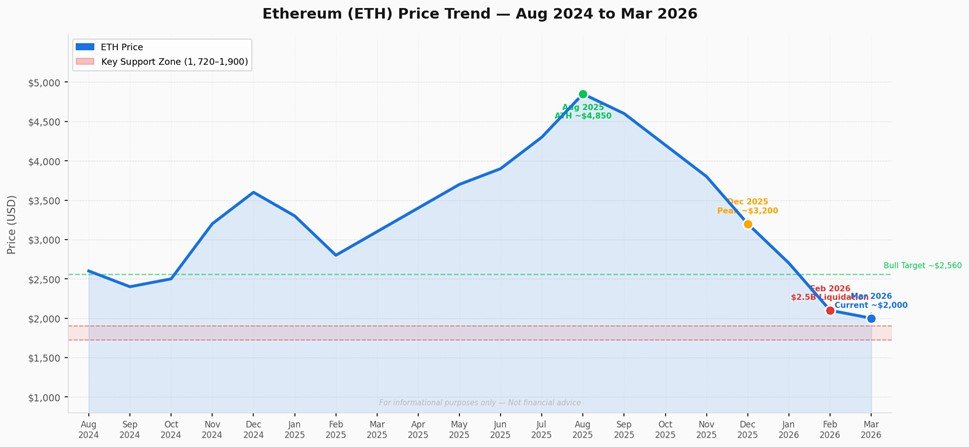
Figure 1: ETH price Aug 2024 to Mar 2026. Key events annotated for informational purposes only.
Also Read


Where Does ETH Stand Right Now?
As of March 2026, Ethereum is trading around $1,900–$2,100, with a market cap hovering around $233 billion. That’s still massive — but it’s a significant drop from the euphoric highs we saw just a few months ago.
Here’s a quick snapshot of the current situation:
| Metric | Value | Context |
| Current Price | ~$1,900–$2,100 | Down ~58% from ATH |
| All-Time High | ~$4,978 (Aug 2025) | Set during bull run peak |
| Market Cap | ~$233 Billion | #2 behind Bitcoin |
| Sentiment | Extreme Fear | Per crypto fear index |
So What’s Causing the Drop?
The crash isn’t random. Several major events have been converging to push ETH downward:
1. Vitalik Buterin Sold ETH
Let’s start with the one that grabbed headlines. Ethereum’s own co-founder, Vitalik Buterin, sold a significant amount of ETH in early 2026. When the creator of a platform starts offloading, it sends shockwaves through investor sentiment — even if his reasons were entirely personal or philanthropic.
2. Whales Dumped Big
Large wallets — think entities holding 10,000 to 100,000 ETH — collectively offloaded more than 1.1 million ETH, worth over $2.8 billion. That kind of volume hitting the market at once is like a tidal wave for prices. It creates panic, triggers stop-loss orders, and cascades into a broader selloff.
3. Institutional ETF Outflows
Since spot Ethereum ETFs launched, institutions have been a key driver of demand. But in recent weeks, major players have been withdrawing funds and moving ETH to exchanges — typically a precursor to selling. When the ‘smart money’ exits, retail follows.
4. The Fed Turned Hawkish
Crypto and tech assets hate rising interest rates. With Kevin Warsh taking over as Fed Chair and signaling a tighter monetary policy, investors are rotating away from high-risk, speculative assets — and crypto is squarely in that category. When the risk-off alarm sounds, ETH gets hit hard.
5. Mass Liquidations
On February 1st alone, over $2.5 billion in crypto positions were liquidated across the market. Leveraged traders got wiped out in minutes, creating a domino effect that dragged ETH — and most of the crypto market — sharply downward.
6. Macro Gloom & Geopolitical Tensions
Add in broader recession fears, global trade war risks, and geopolitical instability, and you get investors fleeing to safer assets like gold and bonds. Ethereum, for all its brilliance as a technology, is still treated as a risk asset in bear markets.
Is This the End — Or Just a Dip?
Here’s the interesting part: the fundamentals of Ethereum are not broken. Not even close.
- On-Chain Signal: Exchange supply of ETH has dropped to near decade-lows. That means long-term holders aren’t selling — they’re actually buying more at these lower prices.
- Developer Activity: Ethereum researchers just released a proof-of-concept for Native Rollups using EIP-8079, a major leap forward for Layer 2 scalability without needing complex ZK circuits.
- Security Investment: The Ethereum Foundation just raised its bug bounty payout cap to $1 million — signaling confidence in the network’s long-term viability.
The bottom line? This correction is macro-driven, not fundamentals-driven. Ethereum’s network is still healthy, growing, and building — the price just hasn’t caught up yet.
Speaking of navigating volatile markets smartly — if you’re looking for a platform built for moments exactly like this one, you’ll want to check out our deep-dive on Crypto30x.com: The Game-Changing Crypto Platform You Need to Know About. Whether you’re looking to track opportunities during a dip or position yourself ahead of the next rally, it’s worth a read before you make your next move.
What Can We Expect Going Forward?
Analysts are divided on the short-term, but more optimistic long-term. Here’s the range of possibilities:
- Bearish Scenario (Next 1–2 Months): ETH could test support at $1,700–$1,850 if macro conditions worsen.
- Base Case (Mid-2026): A recovery toward $2,500–$3,000 as macro headwinds ease and network upgrades gain attention.
- Bullish Scenario (End of 2026): Some analysts project ETH could reclaim $4,000–$5,000 if institutional flows return and the market cycle turns.
- Long-Term (By 2030s): Standard Chartered has floated a price target as high as $40,000, driven by ETH becoming the backbone of decentralized finance and Web3.
What’s Coming for Ethereum’s Tech?
Even in a down market, Ethereum’s developers aren’t sleeping. Two major upgrades are on the 2026 roadmap:
- Glamsterdam — focused on improving transaction efficiency and reducing gas costs for users.
- Hegota — targeting better performance and validator improvements at the protocol level.
These upgrades won’t pump the price overnight, but they strengthen the foundation for when the next bull cycle arrives.
Final Thoughts
Ethereum’s current struggle isn’t a sign of failure — it’s a stress test. Every major technology goes through cycles of hype, correction, and consolidation before it matures. We saw it with the internet in 2000. We saw it with smartphones. And we’re seeing it with blockchain now.
The question isn’t whether Ethereum will recover. Based on developer activity, institutional interest, and long-term fundamentals, it very likely will. The real question for tech-savvy investors and builders is: What are you doing while the price is low?
The builders keep building. The hodlers keep hodling.
What side of that equation are you on?
Disclaimer: This blog post is for informational and educational purposes only. It does not constitute financial advice. Always do your own research and consult a qualified financial advisor before making any investment decisions.